

About 25 years ago, Ted Chewing, known for growing heirloom crops, was given the last two ears of Jimmy Red (James Allen Red) corn by a friend who owned a feed and seed store, hoping Chewing could keep the varietal alive. Chewning said the man who left the last Jimmy Red Corn was the grandson of a Georgian who came to South Carolina to use it moonshine. After growing Jimmy Red for 20 years, Chewning met Glenn Roberts, founder of the milling company Anson Mills, also known for growing several corn varietals and heirloom grains. For decades, Roberts had heard of the local red corn on the islands that, in Roberts’ words, “made good hooch”. Roberts was given enough Jimmy Red seed to distribute it to other farmers and well-known local chefs. In January 2014, Scott met with Glenn Roberts at a research farm at Clemson University while exploring corn varietals. Roberts showed Scott Jimmy Red and explained its history and that it was nearly extinct. The problem was that the only supply of Jimmy Red available was a fraction of what was needed to make bourbon. If Scott and Ann wanted to use Jimmy Red for whiskey, they would have to grow it themselves, which is what they did. In conjunction with Brian Ward at Clemson University’s research farm, 2.3 acres of Jimmy Red were planted in a far corner of his organic farm. The first batch was used for the New Southern Revival Straight Bourbon Whiskey, made with 100% Jimmy Red corn, distilled and barreled in fall 2014.
In 2020, High Wire Distilling moved to a 43,000-square-foot former Sears tire facility to meet increasing demand. The distillery uses about half, leaving room for expansion. The distillery upgraded to an 8,000-liter German-made copper CARL Still with a 4-plate column and pot that can run either through the column or as a straight pot. The 2000-liter Kothe hybrid Pot Still is being used for gin, vodka, and experimental, smaller batch spirits, and a 50-gallon experimental Still for tinkering projects. The CARL Still is used five days a week for whiskey and peach brandy one day a year. High Wire uses a sweet mash, fermented with an ale-top fermenting yeast in the 81 – 83-degree range for about a week. Blackwell says, “We have played around with several yeast strains throughout the years. We have a homebrew beer background, so higher temperature yeast strains, particularly Belgian yeast strains, were of interest to us. These yeasts tend to take a bit longer due to lower temps, but we preferred the flavor over higher-temperature, ”turbo” champagne-style yeasts. At the end of the day, it’s about flavor preference, and we like what we get from ale-type yeasts.” High Wire currently uses Kelvin Cooperage to age its whiskey in air-dried 18 to 24-month seasoned 53-gallon new American white oak barrels, with a Char #3.5, medium toast, and a low barrel entry proof of 110.
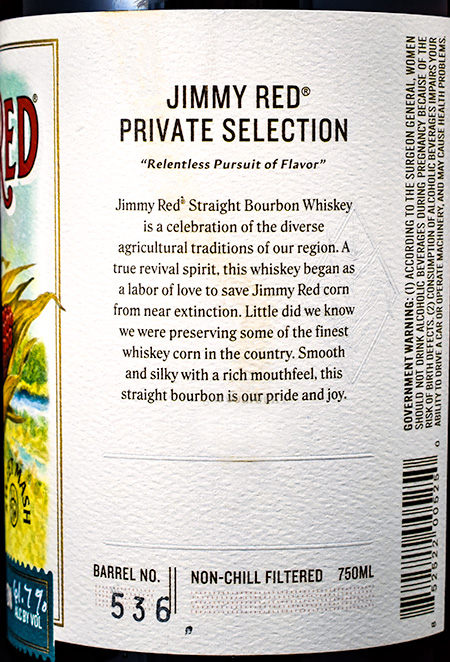 Taken: Neat in a Glencairn glass, rested for about 15 minutes.
Distillery: High Wire Distillery Co. Charleston, South Carolina.
Proof: 123.4, non-chill filtered.
Age: 6 years, 7 months, 3 days.
Selected by:: Seelbach’s. Barrel #536 “Cherokee Tract”.
Mash bill: 100% Jimmy Red Corn.
Retail Price: $99.99.
Appearance: Reddish copper.
Nose
Caramel taffy, toffee, maraschino cherries and red berries, milk chocolate, molasses, hazelnuts, vanilla beans, floral, green tea, and cinnamon spice. With more time, the profile opens up and becomes sweeter with more cherries and berries, chocolate, hazelnuts, and vanilla.
Palate
With a good, creamy mouthfeel, the nose matches the palate with caramel, toffee, maraschino cherries, milk chocolate, cedar, vanilla, floral, and green tea. There’s a cinnamon spice that reminds me of Red Hots candy building up mid-sip, and carries through the finish. The spice initially caught me off guard, but it didn’t overpower the flavors I loved most in this profile, and added a nice balance.
Finish
Lots of cinnamon spice covers the palate with caramel, vanilla, milk chocolate, maraschino cherries, with leather, and tobacco entering the mix. As the sip closes out, the spice continues to tingle the palate with vanilla, leather, and dark tobacco for a long finish.
Conclusion
I’ve been meaning to try Jimmy Red for at least a couple of years, and when I saw this pick from Seelbach’s, it sounded like a good one to buy. The only bourbon I’ve had that contained Jimmy Red corn was the Still Austin Red Corn Bottled-In-Bond bourbon, which uses 36% Jimmy Red, 34% white corn, 25% rye, 5% malted barley. Despite having more differences than commonalities, the Jimmy Red corn’s distinctive fruity cherry flavors and cinnamon spice shone through. I notice an improvement after allowing a whiskey time to open up, but this is especially true with pot-stilled whiskies, and Jimmy Red was no exception. Over the course of a few weeks and several pours, the profile became more cohesive, with better balance. The star of this profile is the rich caramel, toffee, and chocolate mixed with red cherries and berries, which, for me, is a winning combination. There’s also a good mix of vanilla and a herbal-like green tea note that I really liked, too.
The more I got into this bourbon, the more I loved it. I’m impressed with the variety of flavors it has for a single-grain mash bill, and the choices that High Wire Distilling made to craft Jimmy Red, such as using premium Kelvin barrels, a low barrel entry proof, and farming their own nearly extinct corn. It’s worth noting that this review’s barrel was distilled and filled before moving to the new facility, using the Kothe hybrid pot still and aged in a kiln-dried Kelvin barrel. This private selection release is a super enjoyable bourbon, delivering a solid introduction to Jimmy Red. Nearly seven years is a decent age for a bourbon, but I’d love to try Jimmy Red with more time spent in a 24-month seasoned Kelvin barrel. I appreciate all the time and effort High Wire has dedicated to making Jimmy Red what it is today, and I look forward to trying their future releases.
Rating: 7.8/10.


1 | Disgusting | So bad I poured it out.
2 | Poor | I wouldn’t consume by choice.
3 | Bad | Multiple flaws.
4 | Sub-par | Not bad, but better exists.
5 | Good | Good, just fine.
6 | Very Good | A cut above.
7 | Great | Well above average.
8 | Excellent | Really quite exceptional.
9 | Incredible | An all-time favorite.
10 | Perfect | Perfect.


